Hello,
I’m Krista Sabados, LMFT
I’m a licensed marriage and family therapist working with complex trauma, relationship issues, addiction, anxiety, grief, and burnout. I’m trained in the Comprehensive Resource Model, Internal Family Systems, Dialectical Behavior Therapy, Acceptance and Commitment Therapy, Cognitive Behavioral Therapy, grief work, addiction recovery, and somatic approaches, with a Harvard background in adult learning and fifteen years of my own spiritual practice.
I work at the level of the body, not only insight. You don’t have to arrive with the right words, and you never have to perform being well.
My story
A Story of a Wounded Healer
The traditional field of therapy cautions against self-disclosure, and for good reason. A therapist’s story should never become the focus of the therapeutic relationship or distract from a client’s own process. Boundaries matter. They create safety, clarity, and space for the person sitting across from us.
And yet, I have also seen those boundaries pushed so far that something deeply human can get lost.
Therapy is, at its heart, a human experience. Human to human.
I believe there is a way to hold both: strong therapeutic boundaries and genuine humanity. I don’t need to disclose the details of my trauma history for you to know that I have walked my own path of healing. But I do believe that knowing something about the person walking alongside you matters.
Our stories as healers matter, not because they should become the story, but because they shape how we show up, what we notice, what we value, and what ignites our hearts to sit with people through some of the most difficult moments of their lives.
I share mine so you know that you are not alone.
I am human with you. I know something about the courage it takes to walk through the fire of our wounds and find our way to the other side. I know that healing is rarely a straight line, and that sometimes the very things that helped us survive eventually become the things we need to transform.

Why I wanted to be a therapist
My path toward becoming a therapist was not a straightforward one, although I knew as a teenager that I wanted to be a therapist.
As a teenager, I was interviewing a woman at a local care home for a school assignment when I witnessed the inhumane treatment of residents diagnosed with schizophrenia by the staff. I was deeply affected by what I saw. I later became an informal volunteer, spending time with the residents, making art and getting to know them.
What I learned was simple and profound: beneath the diagnoses and labels were human beings with stories, humor, creativity, pain, and an enormous capacity for connection.
When they were treated as human, they showed up as human.
These residents became like a family to me.
As a survivor of complex childhood trauma, I had learned many ways to survive. I created chosen family, cultivated community, and learned how deeply important belonging can be. I also learned to cope by overachieving and taking school very seriously, starting at community college soon after high school.
The detour into education
At the same time, a deep fire was igniting in me to advocate for systems and social change. I was a first-generation college student from a low-income background, and I was lucky enough to be taught by professors Ted Hamilton and Paula Clarke, who deeply believed in my potential, challenged me in the best ways, and taught me the whole concept of “learning how to learn.” My professors encouraged me to move away from psychology and toward education and sociology. My path toward becoming a therapist took a detour.
I don’t regret that detour.
Through my years as an educator, I learned what makes meaningful personal change possible, what helps people feel safe enough to learn and grow, and how systems and intersecting histories can complicate that process. I also learned to conduct human research, which taught me to ask better questions, listen deeply, and examine how my own history and biases shape the way I perceive others.
Eventually, I earned a master’s degree in adult development from Harvard Graduate School of Education, where I sought out the mentorship of Robert Kegan, a psychologist and leading researcher in adult development.
Through his work, I learned that human transformation requires the right balance of support and challenge. We grow when we are pushed to the edge of our comfort zone, but support during that growth is critical.
I also learned the importance of attunement: truly understanding the person or organization in front of you, recognizing their strengths, and building an approach that is responsive to who they are.
I carried this perspective into my work supporting teachers, administrators, and education leaders in youth development nonprofits.

When it caught up with me
Then, early in my professional career, my own mental health crisis emerged.
It happened during a time when my life looked relatively stable. I had a job, a stable home, and a supportive community. It was almost as if my nervous system knew that I was finally safe enough to feel what I had spent much of my childhood and adolescence surviving.
I started therapy and was deeply disappointed by much of the support I received. There was a power dynamic in many therapy rooms that felt deeply unsettling to me. I often experienced therapy as clinical, distant, and disconnected from the kind of human relationship I was longing for.
There was one therapist who was different. I worked with her for several years, and with her I began my own process as a client in Internal Family Systems.
During this time, I also explored spirituality and mindfulness more deeply. I attended trainings with Kristin Neff and Chris Germer in Mindful Self-Compassion, participated in a Mindfulness-Based Stress Reduction course, trained in Reiki, and was introduced to ceremony through Lakota-led sacred lodges. I worked extensively with a shamanic healer for about ten years. Yoga became another way of connecting with and listening to my body.
These practices helped me. They gave me language, tools, community, and ways to stay connected to something larger than myself. They also deeply inform my practice as a clinician today.
But eventually, I realized that some of these practices were also helping me avoid the deeper work. They helped me cope, but they weren’t transforming the patterns underneath: the constant fear, reactivity, anger, and grief.
In some ways, I was using spirituality to run away from myself.
Eventually, it all caught up with me.
In 2015, I left a high-paying job in the Bay Area. I was so consumed by pain that my body was screaming for me to listen.

Coming home to my body
I sought intensive outpatient treatment and also attended a powerful retreat in Big Sur called Transforming Trauma, led by Sarah Weiss. Weiss’s teaching and the experience of coming into my body, almost like coming home, deeply resonated with me.
It was there that I began to understand something that would fundamentally change the way I understood healing:

Healing is not only something we think our way through. It is something we learn to experience in our bodies.
I began learning what it meant to truly create safety in my body, listen to its messages rather than fear them, to feel it and know that I would not be destroyed by what I felt. In this I reconnected with parts of myself I had spent years trying to outrun.
Through connection, community, and practices that helped me access something larger than myself, I began to understand healing differently.
And in that process, I turned back toward the path I had wanted to walk since I was young.
Becoming the therapist I needed
I went back to graduate school to become a licensed marriage and family therapist.
I learned, slowly, that my body could become a place of safety rather than something I needed to escape.
And I began becoming the therapist I had needed all those years ago.
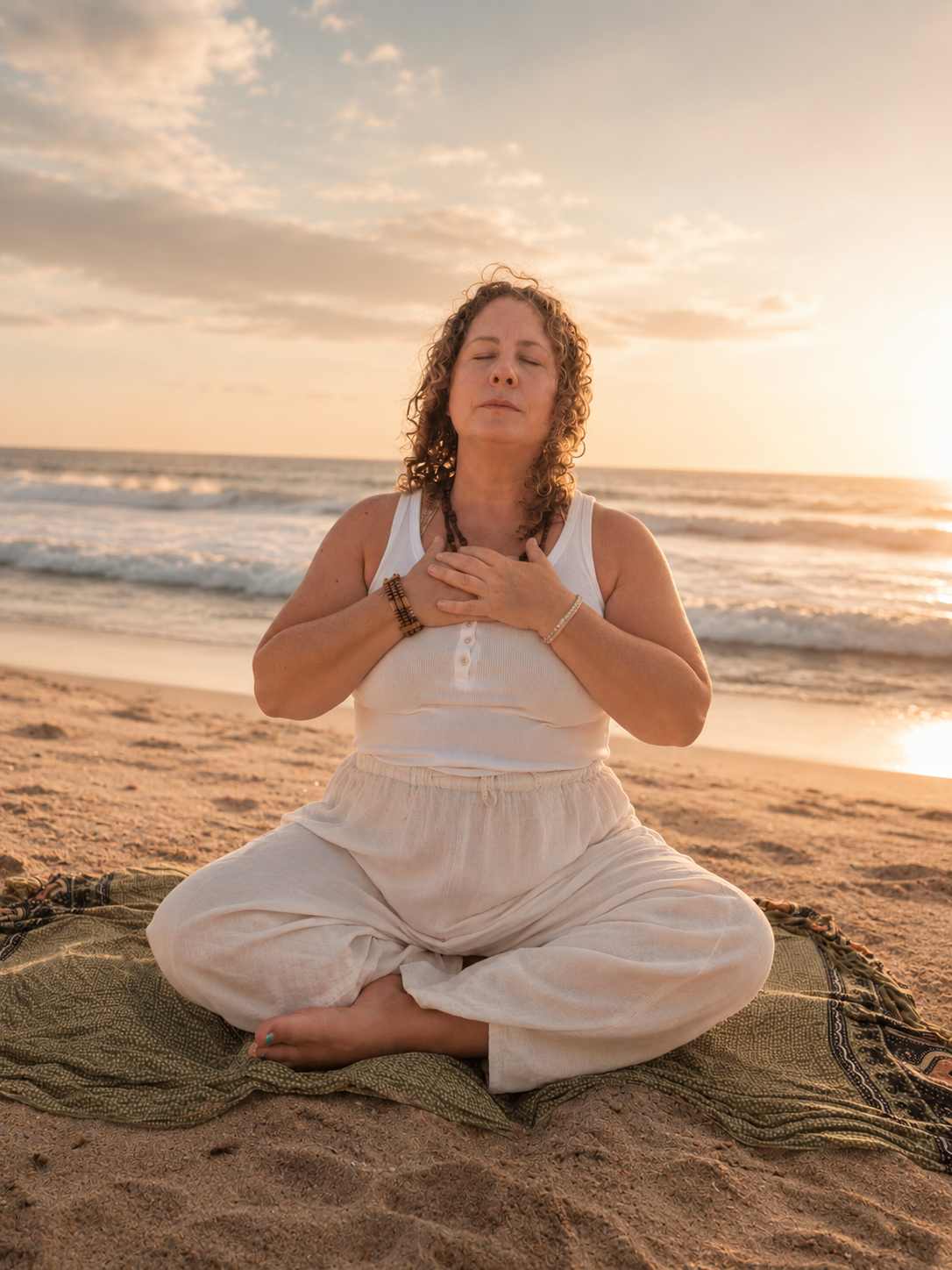
Since becoming a therapist, I have had the honor of holding space for many different people and in many different contexts, including children, teenagers, couples, and adults in both inpatient substance use treatment and outpatient therapy.
I have learned many approaches and practices that can be deeply resonant and helpful, including grief work through Our House Grief Support Center, Internal Family Systems training with Bonnie Weiss, substance use support, Acceptance and Commitment Therapy, EFT and Gottman for supporting couples, and trauma recovery through the Center for Mind-Body Medicine.
But the most important thing I have learned is attunement.
Attunement also means being in our bodies, in our hearts, when we hold space and support others.
We can have all the practices and tools as therapists, but if we are not attuned to our clients, these strategies and techniques are virtually meaningless. I was able to name the important thing that was missing in my previous disappointing therapy experiences.
I was introduced to a therapeutic approach called Comprehensive Resource Model (CRM), which immediately resonated with the work I had begun at that retreat in Big Sur: learning to connect deeply with my body, access my own internal resources, and reconnect with something larger than myself, a sense of Source, connection, and healing.
CRM gave me a framework for understanding something I had been learning through my own healing journey: that our bodies hold wisdom, that we carry resources within us, and that healing can happen when we learn to access those resources with compassion and safety.
How I show up now
Since completing this training, I have continued my own therapy process with a CRM practitioner. I continue to engage in somatic movement and breathwork and to pay attention to the places in me that are still unfolding. It has felt, at times, like watching my own heart unfold like a lotus.
For the first time in as long as I can remember, I feel safe in my body. I feel more free in my authenticity and expression, more deeply connected to my own heart. And from that place, I am able to hold space for others in a way that feels different than it once did.
I don’t show up as someone who has figured healing out.
I show up as someone who is still walking the path. Healing is an ongoing process.
I know what it is to be afraid of what lives inside of you. I know what it is to disconnect from your body because it doesn’t feel safe to be there. I know what it is to use achievement, spirituality, knowledge, or even healing practices themselves to stay one step ahead of pain.
And I also know what becomes possible when we begin, slowly and compassionately, to turn toward ourselves.
That is the kind of healing relationship I want to offer.
A relationship where you don’t have to perform wellness. Where you don’t have to have the right words. Where you can be fully human.
I will bring my training, my multi-disciplinary and holistic lens, my clinical experience, my curiosity, and my presence.
But most importantly, I will meet you as a human being.
Because I believe that healing happens in relationship.

My work is to hold the light steady while you find your way back to yourself.
Training & credentials
Licensure
Licensed Marriage & Family Therapist · California License No. 163813
Graduate education
M.S. in Clinical Psychology, California State University, San Bernardino
Clinical training
Comprehensive Resource Model, trained under developer Lisa Schwartz · Internal Family Systems · somatic approaches · Emotionally Focused Therapy · Gottman Method · Acceptance and Commitment Therapy · Cognitive Behavioral Therapy · exposure therapies
Learning science
Ed.M. in Adult Learning & Transformation, Harvard University · human-centered design
Spiritual lineage
Extensive mindfulness training · 15 years of shamanic healing practice · training in Lakota ceremony · Reiki training · yoga & breathwork
Why We Started
This practice began with a simple conviction: that people deserve more than tools for managing symptoms they never chose. We built it to make room for the slower, deeper work that actually reaches the source.
PN365E2
How We Work
We start by understanding what your patterns have been protecting you from, rather than rushing to manage them. From there the work moves at the pace your body sets, staying with what you feel rather than only what you can explain.
PN365E3
What To Expect
Early sessions are mostly about getting a feel for each other and finding what already helps you settle. There’s no script to keep up with, and nothing you have to be ready to talk about before you are.
PN365E5
Our Promise
Therapy here moves at the pace your nervous system can actually hold, not the pace of a treatment plan. You’ll always know what we’re working on and why, and you can change your mind about any of it.
PN365E1
Heal at the Source
Let’s find out together
The fastest way to know if we’re a fit is a free 15-minute conversation. Bring your questions — I’ll answer them straight.
Book a free 15-minute consult →Or call (949) 401-7956